Filmmaking as Black Ecological Practice
My vision for the future of documentary is tied to its pedagogical utility. For the last two years, I’ve been the lead filmmaker forThe Black Ecologies Lab at Rutgers University. The lab is a collaboration of scholars across institutions to advance scholarship into sites of participatory learning in the U.S. South. So far, we have been to Durham, Virginia, New Orleans, Philly, and Newark. Not only have my films been screened in the U.S. and abroad to local community members, ecological activists, and scholars, I have also begun to develop a curriculum anchor around the films I have produced. This spring (2026), I embarked on a guest lecture tour of several east coast institutions including: the Maryland Institute College of Art (MICA), Rutgers University, The City University of New York, and the University of North Carolina - Chapel Hill. I have visited classes in geography, history, and humanistic studies that hold students from within these disciplines, as well as students majoring in STEM and business-related fields. I initiated this guest lecture tour because of my kinship network of Professors, Doctors, and PhD students. My lecture, Filmmaking as Black Ecological Practice, begins with an icebreaker where I ask participants a simple question: What in your environment or ecology do you want to remember?
I frame ecology as our relationship to the world we live in, and filmmaking as a practice of remembering and documenting that relationship. This opening question grounds participants in how presently they are engaging with their own environments. From there, I give an overview of the fields of Black ecologies and Black geographies, explain my role within them as a practice-based geographer, and prepare participants to watch the Durham Field School documentary. After the screening, I facilitate an interactive discussion activity. Participants break into small groups of four and take observational notes while watching the film. Once the film concludes, they share their observations and compare notes. Together, they work through the final portion of the exercise, where they identify the methods and pedagogies present in the film and consider how those approaches might apply to their own ecological contexts.
Through this process, the documentary becomes more than something to watch. It becomes something to study, discuss, and apply. I am using the answers from the class discussion guides to create visual graphs, summaries, and word maps to tailor plain language for my long-term project of cultivating a K-12 curriculum in Black Ecologies. This project will be tested with an early childhood educator, Joseph Young who teaches middle school english and high school African American history in Kings County, Virginia. I have started the long trek to expanding this network to sites in the U.K., Canada, and the Caribbean. This is how I imagine the future of documentary filmmaking: not only as a medium for storytelling, but as a tool for collective learning, reflection, and engagement across borders and oceans.
2.16.26
Research_Notes_MICA / Guest Lecture: Ways of Writing
Brielle and I started class with poetry: Lucille Clifton- Generations and Tony Dungy- Language. I went into my ice breaker about remembering our ecology. Then we watched the documentary with a group discussion guide. Then a break. Then a group breakout session where we played Destin Conrad’s Tiny Desk. Then share out loud. Then the Lucille Clifton Card Deck was the exit ticket. We collected and recorded answers from each question.
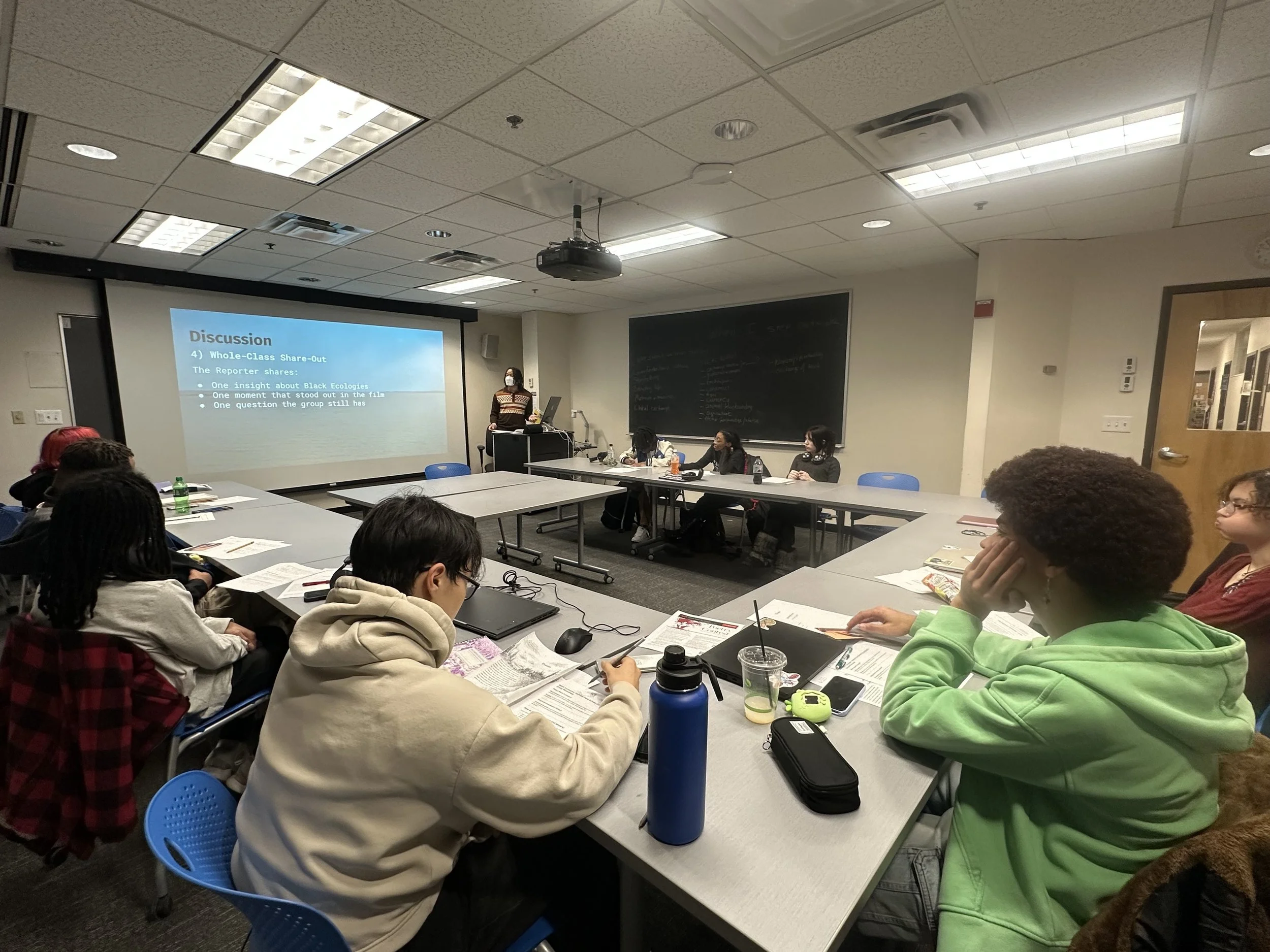
Ways of Writing Classroom at MICA in Baltimore, Maryland
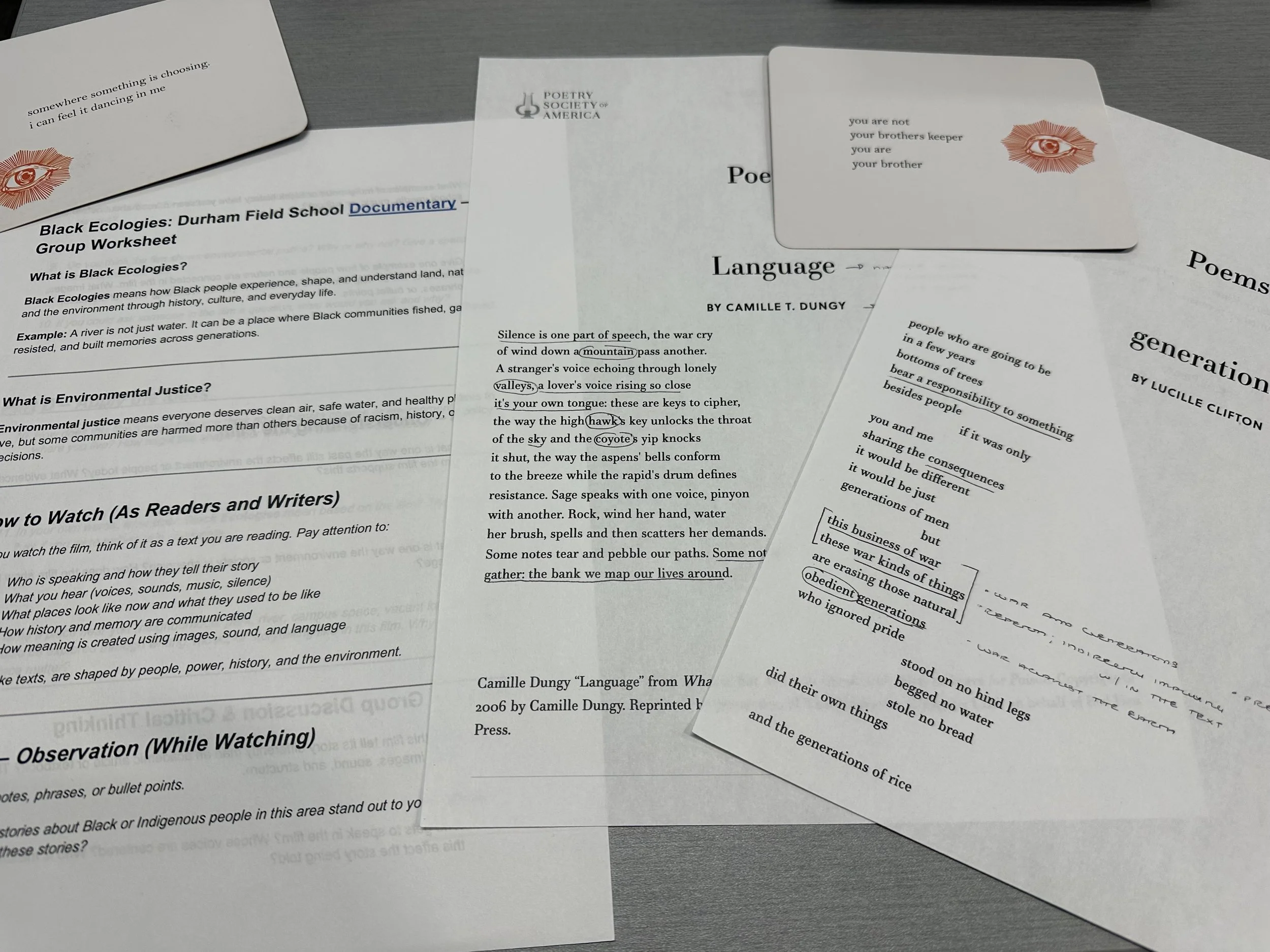
Classroom materials that includes poems, a discussion guide, and tarot card deck.
2.18.26
Research_Notes_MICA / Guest Lecture: Ways of Writing
I talked with Joseph Young today about modifying the discussion guide for middle school students and high school students. Once I finish the tour, especially if UNC Chapel Hill is later in April with J.T. class, I’ll have a good sample of responses to this film. This will help me review and rethink language alongside how we teach black ecologies pedagogy. I also had discussions with Brielle and Devin about a curated exhibition event that is public facing. There are a few options with the book stores and gallery spaces in Baltimore. There could be small interactive elements, ceramics, and textiles.
3.3.26
Research_Notes_CUNY / Guest Lecture: BLACK GEOGRAPHIES AND ECOLOGIES
I kept waking up throughout the morning to see if snow was on the ground and if it was time to leave yet. Washed my face, ate breakfast, did a hip opening yoga (5) min routine and was on my way. I was stressed about getting to the greyhound on time just for it to be late. Dad said before I left that this was his journey too for teaching, going to preach/teach in NY and other places. I’m glad it is just rain today. I still get in my own way sometimes but I know that where I’m at is where I’m supposed to be. Showed up to CUNY and chatted with Alex Moulton in his office. Class was great. Students were engaging with the film and enjoyed filling out the discussion guide. One student stayed after class for help with his final project film. The question of environmental justice was brought up again. What narratives of justice have we been told? Another student talked about the difference from this film and academic articles as being more personal. They had lots to talk about in their groups. They started to apply what they saw in the film to NYC and questions of indigeneity came up. They got to see the people they were reading Jayson M. Porter and Danielle Purifoy in the film. You could see that things were clicking for them since the start of their semester. I had Alex scan all of the discussion guides and sent to me because the students wanted them back. Alex also gave me a book “The End of Supplication, The Invention of Prostrate Blackness.”
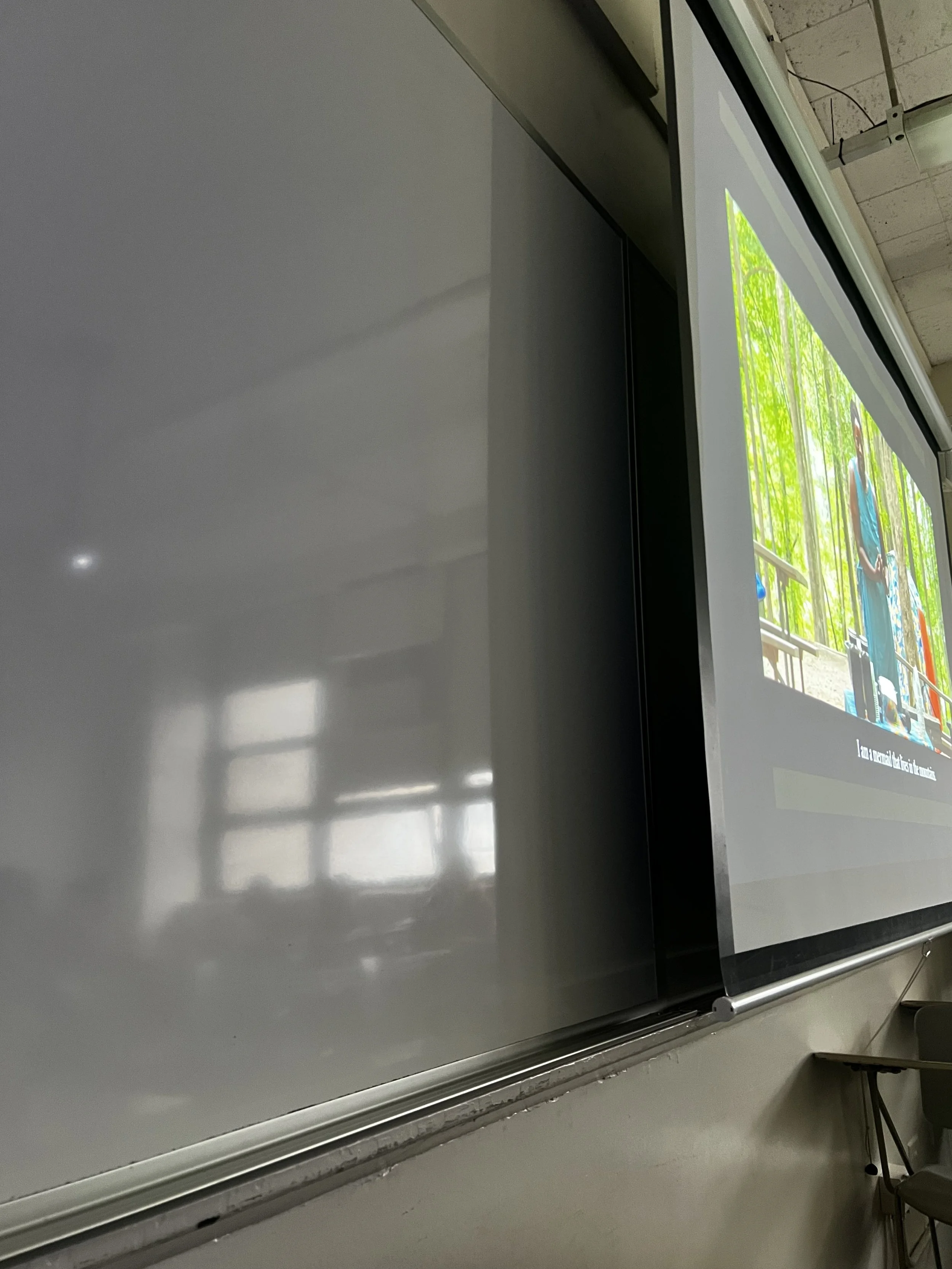
A quick snapshot from my POV during the live viewing of the Durham Documentary
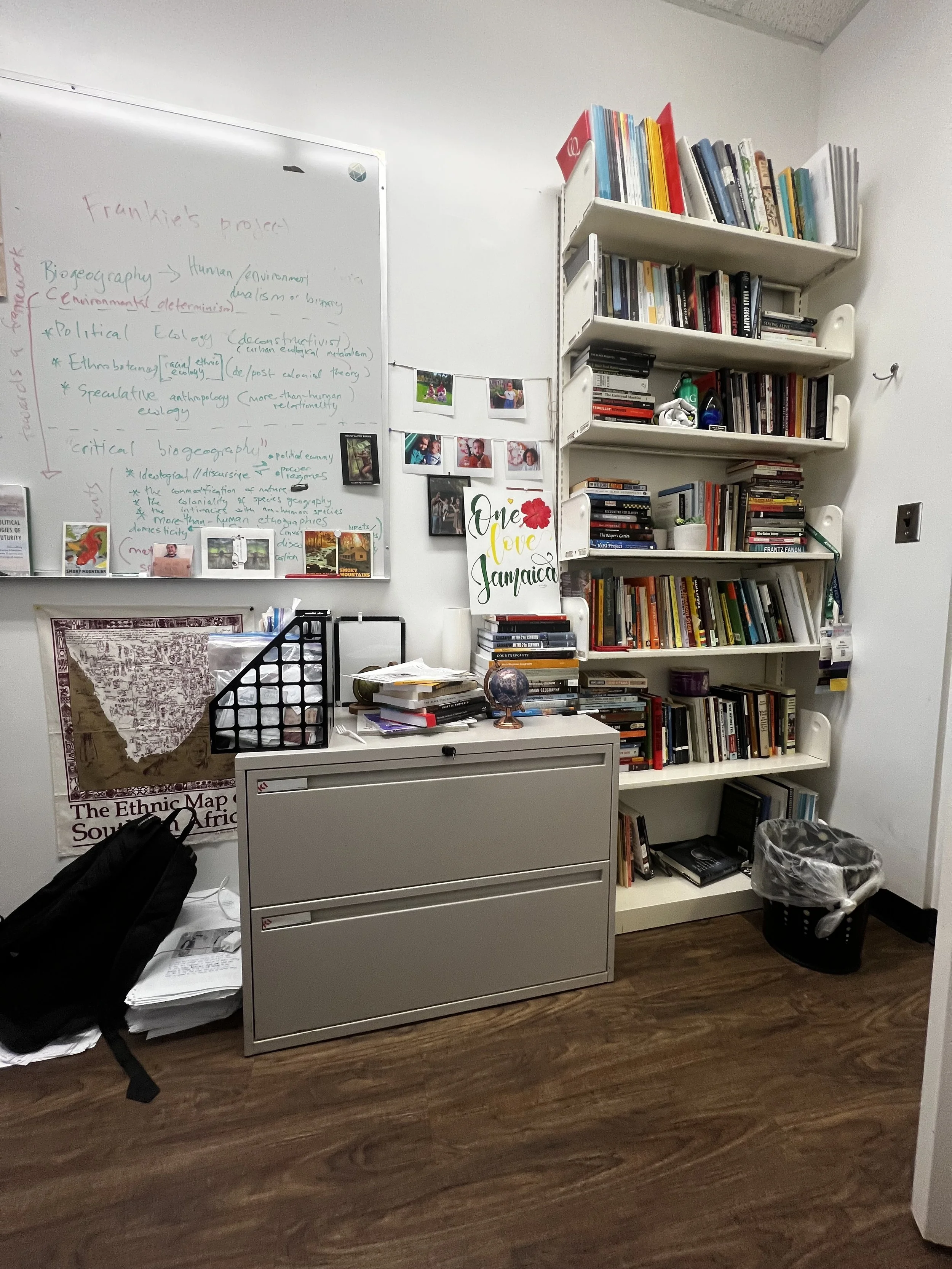
Alex Moulton’s office
3.5.26
Research_Notes_Rutgers / Guest Lecture: Black Nature Writing
Students when discussing the film as a class talked about Asia Dorsey’s chapter in the documentary about Mullein as a plant ally. They were very curious about adaptation across different climates and geographies. In the Stagville chapter they commented on the material world of plantation life and more on the internal world of enslavement. In the Earthseed Collective chapter, they noticed the throughline to Ms. Vivette’s ancestral land of the Occanechi Band of the Saponi Nation there. Teona Williams after the presentation said I have a strong speaking voice and that I am a great educator. She never saw her students engaged so much from a guest lecturer since a lot of them are finance and STEM majors. Teona spoke about Dr. Nxumalo from the University of Toronto who is working with early childhood education in South Africa. She also talked about the Rutgers President is shutting down all DEI programs. Teona also encouraged me to curate the ACE Hotel Black Ecologies Lab (Forthcoming) to engage people outside of black studies and the humanities.
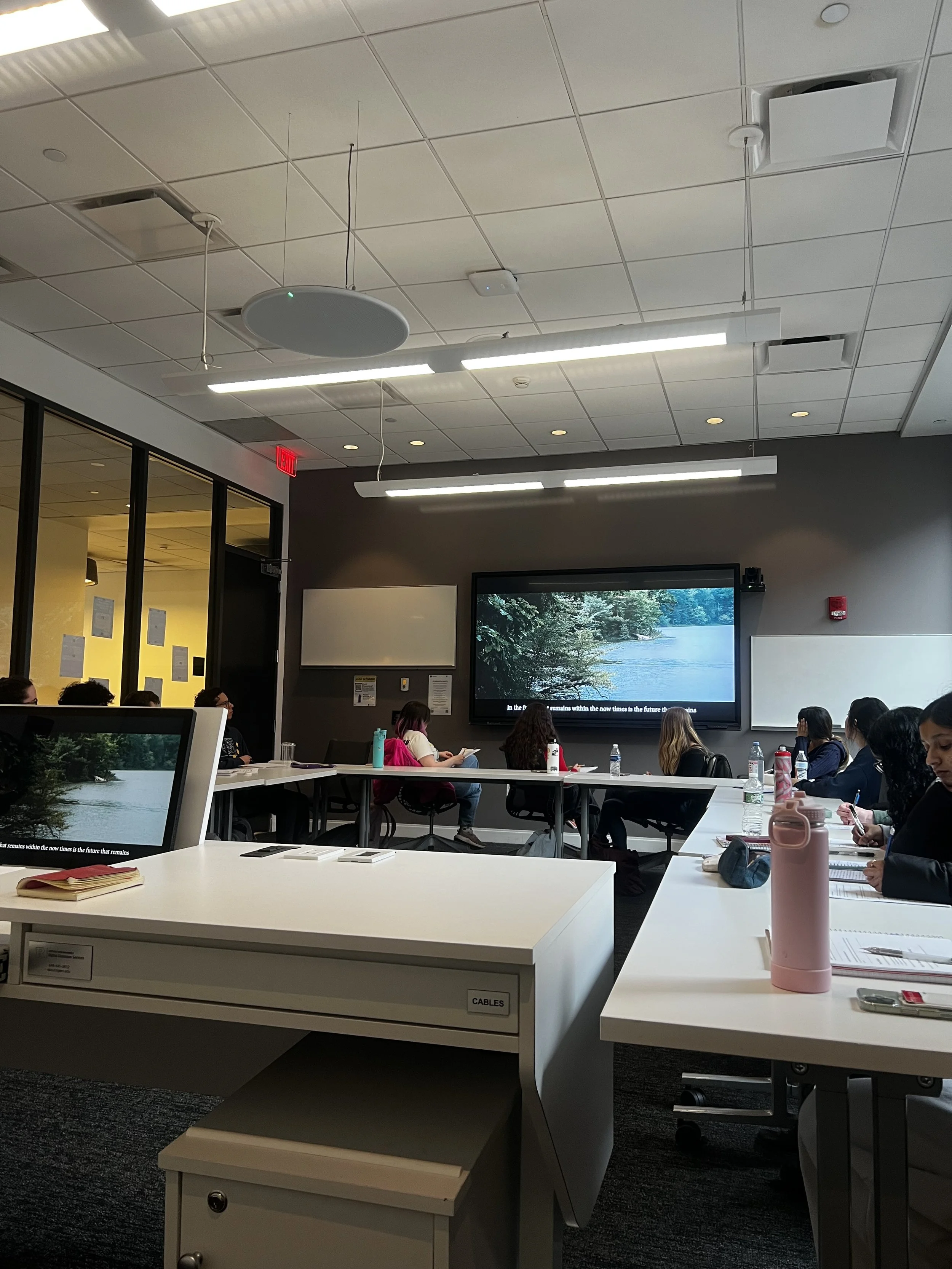
Students taking observational notes on their discussion guides